
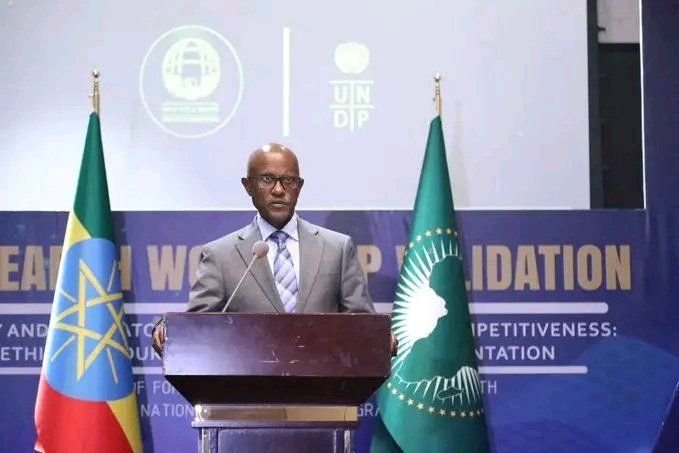
A national validation and dissemination program examining Ethiopia’s readiness for the African Continental Free Trade Area (AfCFTA) was held on Tuesday (November 25) at the Skylight Hotel in Addis Ababa. The event, organized by the Institute of Foreign Affairs (IFA) in partnership with UNDP Ethiopia, focused on the study titled “Policy and Regulatory Harmonization of SME Competitiveness: Ethiopia’s Journey towards AfCFTA Implementation.”
The program aimed to assess Ethiopia’s preparedness for AfCFTA implementation, with particular attention to strengthening the competitiveness of small and medium enterprises (SMEs). The research sought to provide evidence-based policy guidance, highlight gaps in operational readiness, and support national and continental decision-making as AfCFTA moves from negotiation to execution.
The session brought together senior government officials, researchers, diplomats, and development partners, including State Minister of Foreign Affairs Ambassador Hadera Abera, State Minister of Labor and Skills Solomon Soka, State Minister of Trade and Regional Integration Abdulhakim Mulu, IFA Executive Director Jafar Bedru, and UNDP Country Director Samuel Gbaydee Doe.
In his address, Ambassador Hadera reaffirmed Ethiopia’s commitment to continental integration, recalling that the country was among the first to sign the AfCFTA and has now formally moved into the implementation phase. He emphasized that, amid growing global trade pressures and tariff barriers, it is essential for African countries to accelerate negotiations on the remaining tariff lines to ensure the full operationalization of the agreement.
Ambassador Hadera also highlighted the work of the National AfCFTA Implementation Committee, led by the Ministry of Trade and Regional Integration and co-chaired by the Ministry of Foreign Affairs, which is tasked with coordinating national efforts, addressing implementation challenges, and leveraging emerging opportunities in the expanding African market. He further underlined the critical contribution of Micro, Small, and Medium-sized Enterprises (MSMEs) to job creation and inclusive growth, stressing that the government is strengthening productivity, market access, technological capacity, and policy coherence to enhance their competitiveness under the AfCFTA framework.
Highlighting that Ethiopia is advancing SME competitiveness through policy reforms, tariff implementation, capacity-building initiatives, and evidence-driven programs, he underlined the importance of coherent national action supported by ongoing research to guide Ethiopia’s regional trade engagement and ensure businesses benefit from a more integrated African market.
On the occasion, State Minister Abdulhakim commended the partnership between IFA and UNDP, stressing that the program represented a major stride in Ethiopia’s integration into AfCFTA. He described AfCFTA as Africa’s emerging single market and said the framework would enable Ethiopian SMEs to meet continental standards, improve export capacity, and unlock wider economic opportunities.
IFA Executive Director Jafar underscored, on his part, that successful AfCFTA implementation requires collective responsibility. He stressed that Ethiopia’s political commitment must be matched with institutional capacity, regulatory clarity, and logistical readiness. Jafar noted that the newly launched study represents an important step toward identifying the structural gaps that hinder SMEs and toward formulating actionable strategies for Ethiopia’s effective participation in the continental market.
UNDP Country Director Samuel Gbaydee Doe emphasized the pivotal role of SMEs in job creation, inclusive growth, and the broader development agenda. He noted that SMEs form the majority of global businesses yet continue to face barriers such as limited finance, inadequate infrastructure, and fragmented regulations. Doe reaffirmed UNDP’s support for Ethiopia through programs focused on entrepreneurship development, financing solutions, digital skills, and targeted mentorship, particularly for women and youth.
The participants praised the validation session as a critical milestone in Ethiopia’s transition from political endorsement of the AfCFTA to its practical implementation. The study’s findings indicate strong policy alignment but also highlight notable functional gaps. Major gaps identified include digital readiness, standards compliance, customs systems, institutional coordination, and SME awareness.
The event also offered a platform for stakeholders to emphasize the need for coordinated action to ensure that SMEs are fully prepared to seize the opportunities offered by Africa’s emerging single market.