
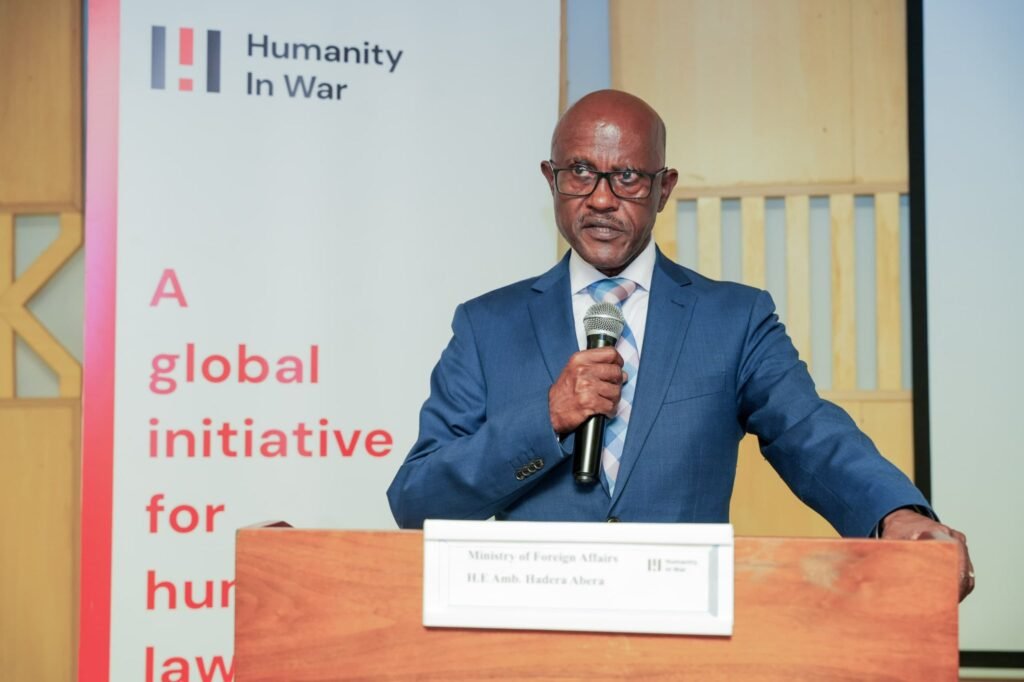
Ethiopia hosted a high-level workshop on March 4–5 at the Adwa Victory Memorial in Addis Ababa in collaboration with the International Committee of the Red Cross and the African Union Commission, aimed at fostering deeper dialogue on the role of disarmament in reinforcing humanitarian norms and promoting sustainable peace. The discussions examined how humanitarian demining and arms-transfer controls can serve as practical tools for peacebuilding.
The event brought together around 100 experts and officials from African Union Member States, along with technical specialists from demining and humanitarian organizations. Representatives from partner countries including Norway, Switzerland, and Saudi Arabia also participated. The expert workshop and accompanying high-level panel discussions explored how International Humanitarian Law (IHL) can contribute to peace and disarmament efforts across the continent while seeking to translate technical findings into practical recommendations ahead of the 2026 global meeting in Jordan.
In his opening remarks, State Minister Ambassador Hadera Abera emphasized that disarmament represents both a legal obligation and a practical mechanism for ensuring compliance with IHL. He highlighted Africa’s resilience and its continued commitment to peace in line with the aspirations of Agenda 2063, while noting Ethiopia’s ongoing efforts to advance humanitarian disarmament. Ethiopia currently serves as co-chair of the IHL and peace workstream under the global initiative, reflecting the principle of “African solutions to African problems.” Within this framework, disarmament is viewed not only as a security issue but also as a humanitarian imperative that supports the conditions necessary for lasting stability.
Representatives from the African Union and the International Committee of the Red Cross also addressed the workshop. Sheku Tejan Sesay of the African Union and Erik Tollefsen of the ICRC highlighted approaches to reducing civilian harm through strengthened policy frameworks. They noted that while technical solutions for improving compliance with humanitarian norms already exist, their effective implementation requires sustained political commitment. The discussions produced practical recommendations for African states on strengthening arms-transfer controls and advancing humanitarian demining efforts.
These discussions take place at a time when the global security landscape remains highly complex. According to the International Committee of the Red Cross, approximately 130 active armed conflicts were recorded worldwide as of early 2026. In response to these challenges, a group of states including Brazil, China, France, Jordan, Kazakhstan, and South Africa, in partnership with the ICRC, launched the Global Initiative to Galvanize Political Commitment to International Humanitarian Law in September 2024. By early 2026, more than 100 states had joined the process.
The initiative is structured around seven thematic workstreams designed to translate dialogue into concrete and actionable recommendations for the 2026 high-level conference in Jordan. These workstreams address several pressing challenges in contemporary armed conflict, including the digitalization of the battlefield, the protection of essential civilian infrastructure, the humanitarian implications of naval warfare, and the relationship between disarmament and sustainable peace.
Ethiopia, together with Bangladesh, Colombia, Qatar, and Saudi Arabia, co-chairs the workstream on IHL and peace. The central premise of this workstream is that respect for International Humanitarian Law constitutes a strategic investment in long-term peace. Compliance with the rules of armed conflict can help reduce human suffering and social fragmentation, which often fuel cycles of violence. Measures such as protecting civilians, treating detainees humanely, and clarifying the fate of missing persons contribute to preserving the social fabric necessary for recovery and reconciliation.
The 2026 conference in Jordan is expected to provide an important opportunity for states to reaffirm their commitment to the Geneva Conventions through the adoption of practical and cross-cutting measures. The success of this process will depend on sustained international cooperation and a shared recognition that restraint in conflict can help preserve the conditions for future peace.
Within the African context, the integration of humanitarian law and disarmament is increasingly seen as essential to advancing the Silencing the Guns initiative of the African Union and the broader aspirations of Agenda 2063.