
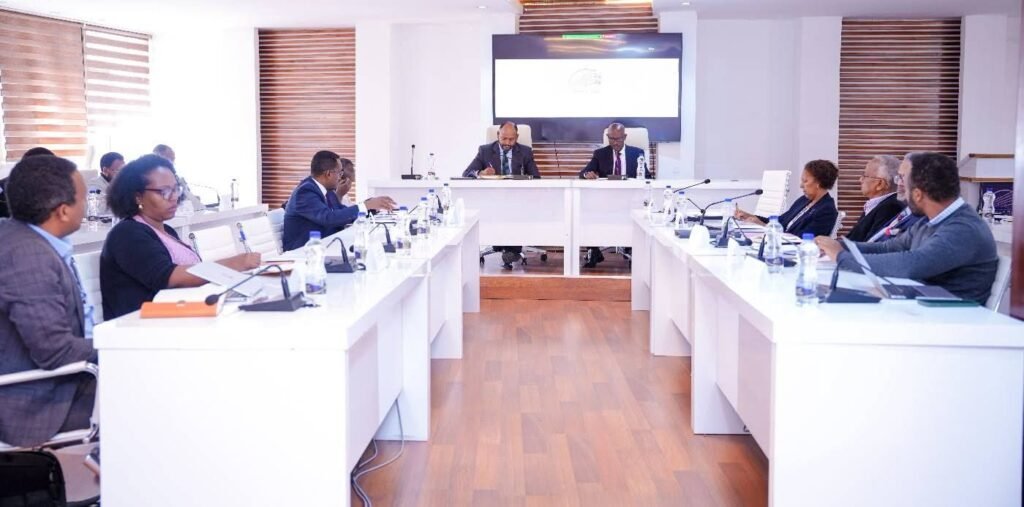
The Ministry of Foreign Affairs held a consultative forum on August 17 and 18. The consultative forum titled “Ethiopia and the interconnected geoeconomic trends” aims at leveraging Ethiopians’ intellectual capital to conceptualize contemporary international relations and deliberate on operationalizations in pursuit of Ethiopia’s national interests, attracting researchers from several think-tanks and universities.
The core foundation, captured by Ambassador Hadera Abera’s opening speech at the consultative forum, has four pillars, often referred to as Ethiopia’s 4As, first outlined by Prime Minister Abiy Ahmed in his June 2025 televised address. Accordingly, the reformed foreign relations approach has become active in its pursuit of proactive and independent engagement in global relations; sought alternatives through the establishment of non-aligned and diverse diplomatic partnerships; become adaptive, displaying enhanced flexibility and non-ideological situational awareness; and graduated to becoming Agenda-Setter by enhancing the ability to move from passive execution of global mandates toward embracing and assuming leadership roles in the delivery of a new international order.
The overall objective of such a transformative foreign policy agenda is to enable Ethiopia to seize emerging opportunities, protecting its national interests from the uncontrolled competition of external actors, who are seeking to carve out spheres of influence in the Horn of Africa and the Red Sea at Ethiopia’s costs.
In this forum, invited participants presented their outlook on a number of regional and global issues, which have significant influence on Ethiopia’s foreign relations and regional stability. The consultation highlights the interlinkages between several localized and regional conflicts and the Horn of Africa and the Red Sea regions become unrestricted playgrounds for middle and great powers, whose presence, withdrawal, and maneuvers relegate regional peace and stability as a secondary objective. In this regard, the consultation underscored that Ethiopia’s peace, stability, and prosperity is closely linked with its proactive foreign policy.
The consultative forum also gathered senior experts from respective government institutions, such as the Ministry of Finance, the Ministry of Trade and Regional Integration, the Ministry of Tourism, the Ministry of Labor and Skills, the Ethiopian Investment Commission, and Ethiopian Investment Holdings. The main goal of the first consultation on “Ethiopia and the interconnected geoeconomic trends” was to inform strategy based on the data and strategic foresights from across the economic apparatus of the Ethiopian republic.
The consultation underlined the centrality of Ethiopia’s Homegrown Economic Reform, a transparent, market-oriented economic reform, which resulted in elevating Ethiopia to one of the biggest economies in Africa, maintaining a double-digit growth rate. The reform has expanded the economy, managed inflation, ascertained food sovereignty, boosted industrial capacity, enhanced energy security, grown export earnings, created jobs, revitalized tourism, and structurally reformed the public service sector, boosting Ethiopia’s regional and global standings, which partly explain or explained by the reemergence of Addis Ababa as a global diplomatic hub. In this regard, the consultation underscored that Ethiopia’s economic trajectory, given the wide range of geoeconomic trends discussed, can only be sustained by a proactive foreign policy.
The deliberations stressed that the post-Cold War international order, once shaped by established normative frameworks, has in recent years come under increasing strain, contributing to greater fragmentation in international governance. The fracture has resulted, as much as it is influenced, in uncontrolled geopolitical competition where the weakening of international cooperation creates new risks — and new opportunities — for countries ready to act on them. For Ethiopia, which sits at a strategic crossroads for global trade and security, adhering to the business as usual paradigm is a strategic liability.
Gedion Timothewos, Ethiopia’s Foreign Minister in his article published in June 2025, argued that the current global landscape is defined by fragmentation. The rise of extremist political parties, protectionist economic policies, and the unpredictable behavior of middle powers continue to undermine international cooperation, thereby challenging global peace and prosperity. The complexity also results in the proliferation of rivalries, alliances, and initiatives, undermining and sometimes fracturing regional security architectures. A typical manifestation being the transformation of localized conflicts into regional crises, inviting and mainstreaming external provocation.
As Ethiopia navigates this shift from rules-based diplomacy to raw power politics, the necessity for a strategic foresight has become the cornerstone of its diplomacy. Thus, reforming its foreign service to involve more voices in decision-making has been one demonstration of Ethiopia’s foreign policy architectural reform. The structural foundation of the diplomatic reform is the same adaptive framework outlined above, designed to help the country seize emerging opportunities while, at the same time, withstand the unpredictable behavior of global actors in an increasingly fractured world.
Active, adaptive, alternative-seeking, and proactive statecraft, all panels agree, will ascertain Ethiopia’s trajectory as an architect of geopolitical and geoeconomic reality in the Horn of Africa and the Red Sea regions, a force of stability, and a responsible leader in Africa. The number of actionable recommendations that emanate from the consultations that will be integrated into Ethiopia’s strategic document. The strategic consultations on integrative trend analysis demonstrates that Ethiopian diplomacy has moved toward a proactive, participatory approach designed to help navigate steadily in the future of interconnected unpredictability.