
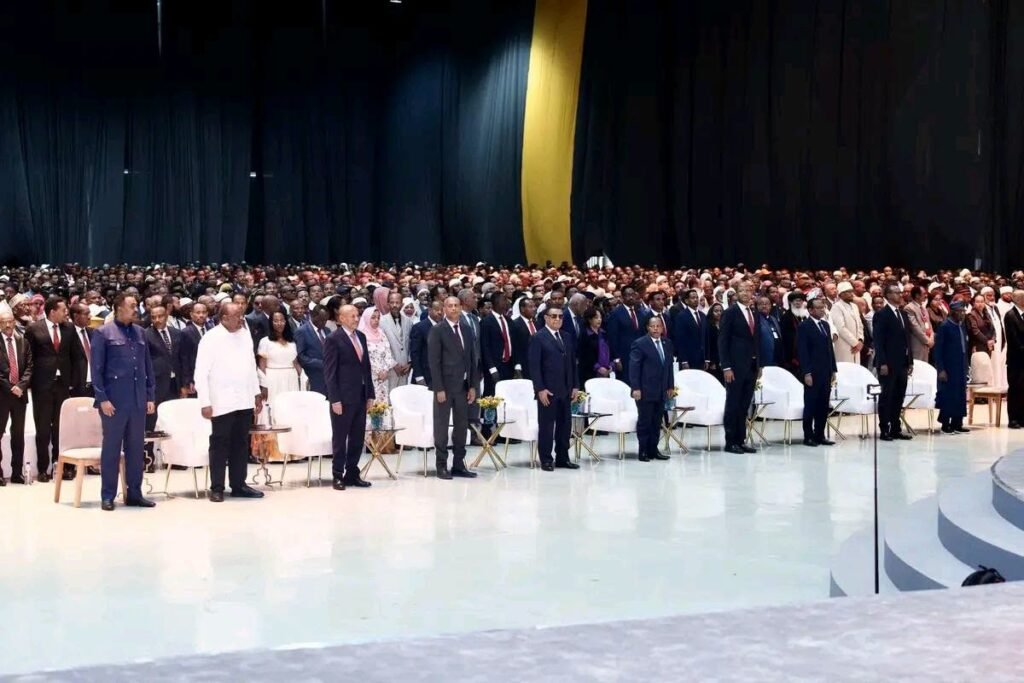
The Ethiopian National Dialogue Conference was officially concluded on Saturday (August 22), with a closing ceremony held at the Addis International Convention Center. The ceremony marked the conclusion of a 46-day process that brought together Ethiopians from different parts of the country and the diaspora to deliberate on major political, social and national issues.
The closing ceremony was attended by President Taye Atske Selassie, former President Mulatu Teshome, senior federal government officials, regional leaders, members of the National Dialogue Commission, former Kenyan President Uhuru Kenyatta, former Nigerian President and AU High Representative for the Horn of Africa Olusegun Obasanjo, IGAD Executive Secretary Workneh Gebeyehu, members of the diplomatic community and other invited guests.
Chief Commissioner of the National Dialogue Commission, Mesfin Araya, highlighted the scale and significance of the undertaking, noting that around 4,000 participants had remained together for 46 days and developed mutual understanding through the process.
President Taye Atske commended the participants for completing the 46-day deliberations and expressed appreciation to the National Dialogue Commission for its extensive efforts. He said participants had brought the experiences and perspectives of their respective communities into the national forum, deliberated and debated their differences, and produced recommendations reflecting shared national aspirations. The President described the process as a historic achievement that had given structured form to Ethiopia’s longstanding culture of dialogue as an instrument for addressing national challenges and advancing modern nation-building.
The President also emphasized the importance of conducting political discourse with civility and mutual respect. He stressed that the dialogue was not intended to provide a temporary political settlement but to chart a sustainable roadmap for Ethiopia’s growth, adding that its recommendations should be viewed as living ideas capable of developing across generations. He further underscored that the process demonstrated Ethiopians’ capacity to listen to and respect one another and expressed hope that its recommendations would contribute to the country’s continued progress and unity.
Former Kenyan President Uhuru Kenyatta congratulated the Ethiopian people and the National Dialogue Commission on the achievement. He commended the Commission for confronting difficult national questions, listening to thousands of voices and bringing diverse experiences together in pursuit of national consensus. He stressed that the conclusion of the conference should be viewed as the beginning of a broader journey, calling for inclusive implementation of the recommendations and emphasizing that Ethiopia’s diversity should serve as a foundation for unity rather than division. He also underscored the importance of Ethiopia’s peace and stability to the wider region.
Former Nigerian President and AU High Representative for the Horn of Africa, Olusegun Obasanjo, congratulated the Prime Minister and the Commission on the conclusion of the dialogue. He emphasized that national dialogue is essential to promoting peace, security and stability, which are vital for national development and the wellbeing of citizens. He described the 46-day process involving 4,000 participants as a historic undertaking that could serve as an example for Africa.
State Minister for Foreign Affairs Ambassador Berhanu Tsegaye, reflecting on the conclusion of the conference, described the peaceful conclusion of the National Dialogue as an important milestone in Ethiopia’s pursuit of peace and national consensus. He stressed that the conclusion marks the beginning of a culture in which peaceful engagement becomes a preferred means of addressing differences, adding that Ethiopia’s experience could offer hope to Africa and the wider world.
The National Dialogue was convened as an inclusive platform to address differences through dialogue rather than confrontation, following a four-year, citizen-driven preparatory process involving nationwide consultations, participant selection, agenda development and public awareness activities. Its agenda covered state-building, identity and history, federalism, religious affairs, rule of law and human rights, socio-economic development, anti-corruption, peace building and reconciliation.
The conclusion of the National Dialogue marks both an achievement and the beginning of a new phase of national engagement. Its recommendations serve as roadmaps for Ethiopia’s political and national development, raising hopes that the emphasis on dialogue, inclusion, reconciliation and peaceful political engagement will contribute to a more peaceful and cohesive Ethiopia while offering valuable lessons for Africa and beyond.