
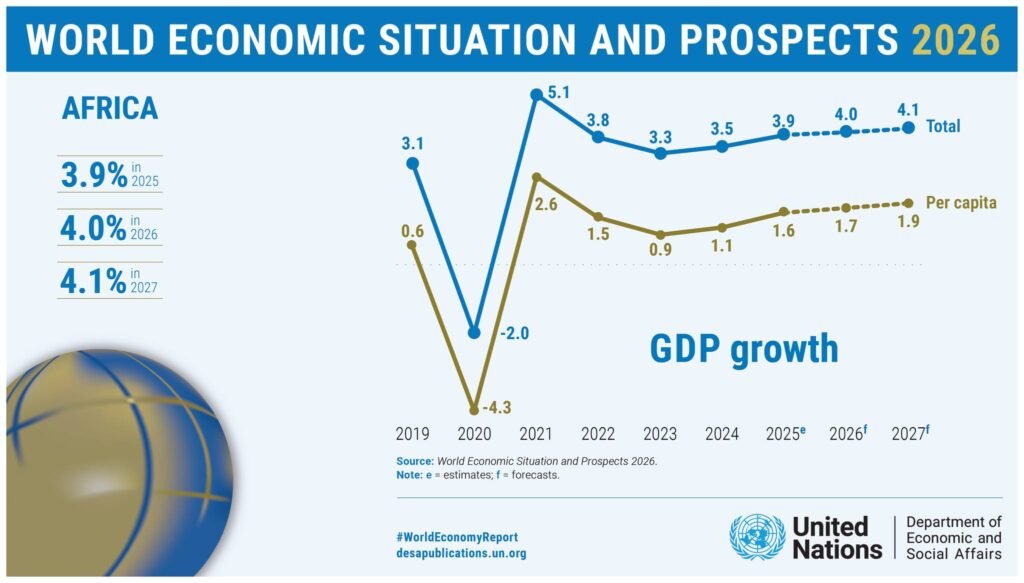
The United Nations has launched its annual Global Economic Outlook for 2026, noting that despite heightened global uncertainty driven by trade tensions, geopolitical and geo-economic pressures, and policy unpredictability, East Africa is projected to record notable economic growth.
According to the Outlook, Ethiopia is expected to sustain strong economic growth in 2026, with the report highlighting the broader positive spillover effects of the country’s economic performance across the East African region. It notes that East Africa continues to benefit from deepening regional integration and the expansion of renewable energy capacity, including developments following the inauguration of the Grand Ethiopian Renaissance Dam in September 2025.
At the global level, economic growth is projected at 2.7 percent in 2026, compared to 2.8 percent in 2025. Despite a subdued global environment, Africa’s economy is expected to grow by an average of 4 percent, with regional variations across North Africa (4.1 percent), West Africa (4.4 percent), Central Africa (3.0 percent), and Southern Africa (2.0 percent). East Africa is projected to outperform other sub-regions, with growth estimated at 5.8 percent.
Among least developed countries, which are projected to record average growth of 4.6 percent, Ethiopia, Bangladesh, and Tanzania are identified as strong performers. The report attributes Ethiopia’s outlook to improved macroeconomic stability, resilient agricultural production, favorable price trends for selected commodities, including gold, and sustained domestic demand amid ongoing reforms supported by IMF programs. It also cites Ethiopia as an example of effective grain production and storage practices that have contributed to price stabilization and improved distribution.
The WTO publication African Trade and Investment for Global Resilience further supports the Global Economic Outlook’s assessment, underscoring Ethiopia’s economic performance in relation to policy efforts aimed at promoting employment-generating investment sectors.
While the overall outlook for Africa remains positive, the reports caution that high debt levels and constrained fiscal space continue to pose challenges. Growth in least developed countries is also expected to remain below the 7 percent threshold required to achieve the Sustainable Development Goals.