
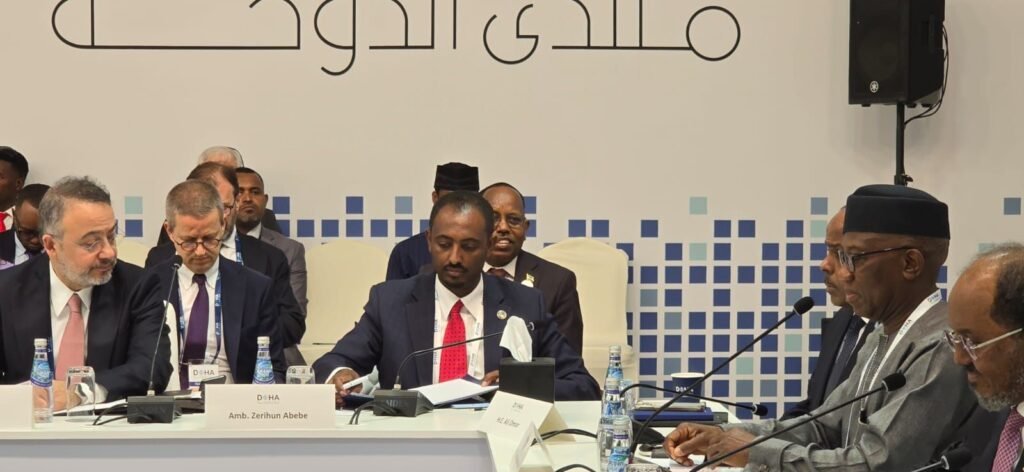
Ethiopia participated in the Doha Forum, which was held in Qatar from December 6 to 7, under the theme “Justice in Action: Beyond Promises to Progress.” An Ethiopian delegation led by Ambassador Zerihun Abebe, Director General for African Affairs at the Ministry of Foreign Affairs of Ethiopia, joined high-level representatives of states, international partners, and institutions in a roundtable session to discuss state-building efforts in Somalia. During the session, he outlined Ethiopia’s historical engagements in Somalia and the sacrifices made to support the state-building process, taking into account the challenges currently faced and possible future trajectories.
Somalia’s state-building initiative requires a non-conventional approach. It is an effort to accomplish two tasks concurrently: combating a deadly terrorist threat on one hand and undertaking activities to rebuild destroyed institutions and provide basic public services on the other. Ethiopia has been supporting the people of Somalia for decades. Ethiopia’s efforts in combating terrorist groups are well documented. The national security of both Ethiopia and Somalia is inseparable. As Somalia is not an option for Ethiopia, nor is Ethiopia an option for Somalia, and considering the natural bond between the two peoples, Ethiopia has been playing an active role in supporting the state-building efforts in Somalia.
Ethiopia strongly believes that genuine partnership is required to complete the state-building process in Somalia. Hence, international partners that engage in Somalia must act diligently, genuinely, and with a unity of purpose. Such partnerships represent investments in regional and global peace and security. Any approach that negates a common purpose is likely to fail and could lead the region into uncharted waters. Actors with malicious interests in the region should consider carefully before taking any futile actions, as Somalia is neither a political theater nor a geopolitical chessboard for anyone. Those actors who wish to play a role in Somalia’s state-building process should also recognize the regional and global significance of peace and stability in the Horn of Africa, rather than advancing inflated selfish interests. That is the manner in which one can genuinely assist the efforts of the people and government of Somalia in achieving successful state-building.
The primary actors responsible for peace, stability, and the building of institutions in Somalia are the political elites and various societal actors. In this context, Somalia should also be able to overcome its internal political challenges through dialogue. International partners can support efforts for dialogue, compromise, and a sense of common purpose to ensure a stable, democratic, and prosperous Somalia.
Ethiopia further calls on the international community to seriously consider the persistent security threats posed by the terrorist group Al-Shabaab and to honor their commitments to Somalia’s stability through funding the African Union Support and Stabilization Mission in Somalia (AMISOM). Considering the level of threat posed by Al-Shabaab to Somalia, the region, and the world, efforts to dismantle the terrorist group should be intensified. Ethiopia, recognizing the inseparability of its own security from that of the region, will continue to play a leading role in combating terrorism.